Dentist and artist Đăng-Vũ Đặng explores Vietnamese identity through creative work
A Dutch dentist's artistic practice explores Vietnamese heritage and diaspora identity through food, water, and cultural objects.
Đăng-Vũ Đặng is a dentist in The Hague who recently completed a part-time degree at the Gerrit Rietveld Academie, one of the Netherlands' leading art schools. His creative practice explores his bicultural and diasporic identity as a Vietnamese-Dutch artist, using his personal history and family heritage as a foundation for work across performance, documentary, ceramics, video, and installation.
Family history and the choice to become a dentist
Đặng's family fled Vietnam in 1981 and was rescued by a Dutch ship. His parents felt strongly that their children should pursue respectable professions and contribute to Dutch society. Though Đặng showed early talent for drawing and craft, and had a strong aptitude for science, he was initially rejected twice from art school. He enrolled in Biomedical Sciences, then was accepted to study dentistry at ACTA (now University of Amsterdam). During his dental training, he would sit by a window overlooking the Gerrit Rietveld Academie, where his twin brother was studying art. Five years ago, he began a part-time art degree while working full-time as a dentist.
Art exploring diaspora, water, and cultural heritage
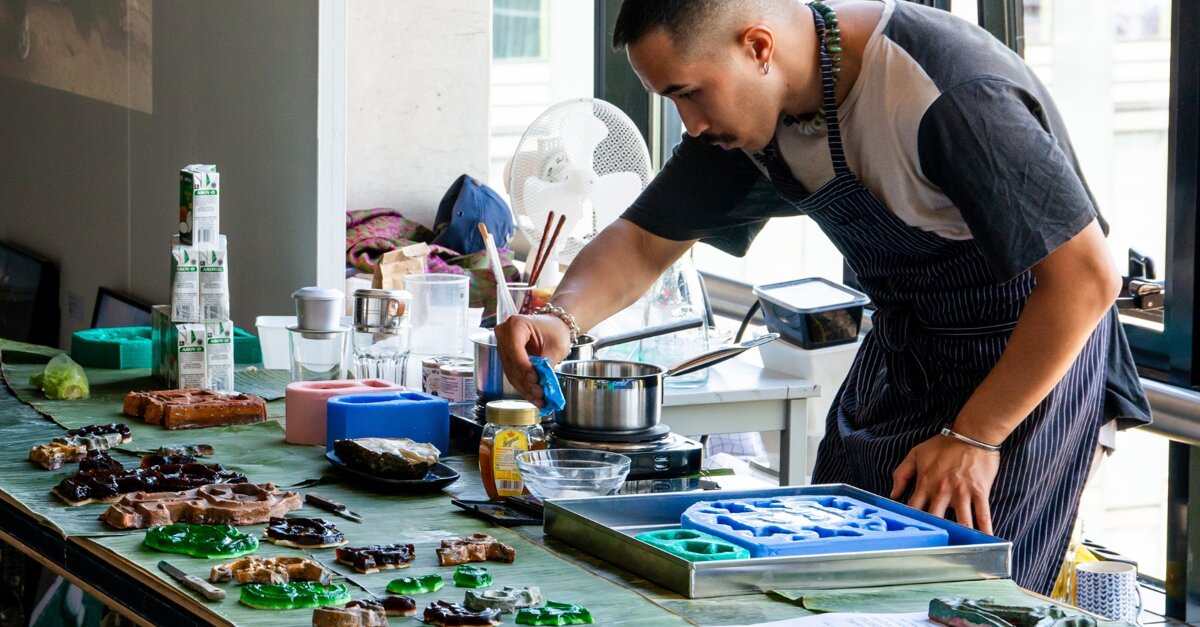
Đặng's artistic work addresses what it means to belong to the Vietnamese diaspora. Water is his central medium: he sees both Dutch and Vietnamese cultures as fundamentally shaped by water and uses it to link his two worlds. For his graduation project, he presented multiple bodies of work developed over three years, including a cooking performance based on fragments from an imperial tomb of the Nguyễn dynasty that he smuggled from Vietnam in 2022. Visitors are invited to cut and eat the dessert while discussing the ethical questions surrounding cultural heritage ownership, intergenerational trauma, and colonial history.
In late 2022, Đặng traveled to Vietnam to find his ancestors' burial site in Kim Sơn in the north, which his grandparents had fled after the French defeat at Điện Biên Phủ in 1954 divided the country. He collected soil from the ancestral cemetery, mixed it with water from the Markermeer near his birthplace in Hoorn and groundwater from his parents' birthplace, and created a ceramic work incorporating self-portraits made from ice formed from water collected in both countries. He documented this journey in the film Cây Cầu Đến Tổ Tiên Tôi (The Bridge to My Ancestors).
Another significant project, Serving FACE, presents self-portraits made from Vietnamese food. Đặng notes that in his family, love was primarily expressed through cooking and shared meals rather than direct emotional conversation. The series functions as a tribute to the women in his family, particularly his mother and aunts. Since graduating in 2025, Đặng has sold multiple works, received commissions, exhibited in four Amsterdam galleries, and won the public prize at Best of Graduates at Galerie Ron Mandos. Though he initially expected to remain a full-time dentist with art as a side practice, his career has progressed faster than anticipated.
Frequently asked questions
What is Đăng-Vũ Đặng's professional background?
Đặng is a dentist working in The Hague who recently completed a part-time art degree at the Gerrit Rietveld Academie while maintaining his dental practice.
Why does Đặng use water as a central element in his art?
He sees both Dutch and Vietnamese cultures as fundamentally shaped by water and uses it as a medium to connect his two cultural worlds and explore shared histories.
What is the cooking performance project about?
For his graduation work, Đặng created a cooking performance based on fragments from an imperial Nguyễn dynasty tomb smuggled from Vietnam. Audiences participate by eating the Vietnamese dessert while discussing questions of cultural heritage ownership and colonial history.
How does food appear in Đặng's artistic work?
His project Serving FACE presents self-portraits made from Vietnamese food, serving as a tribute to the women in his family who expressed love and cultural connection through cooking rather than direct emotional conversation.
What success has Đặng achieved since graduating from art school?
In the four months following graduation in 2025, he sold multiple works, received commissions, participated in four Amsterdam exhibitions, and won the public prize at Best of Graduates at Galerie Ron Mandos.